Week 6 - Lesson Plan
Overview
- A range of practical and expressive coping strategies to help them when they feel anxious or stressed or as a preventative tool to manage stress
- Use of the Peaceful Kids Coping Cards
- How to use an effective problem-solving method when they are feeling anxious or worried about a situation
- Activity: storytelling ("Amaya's Anger" book), craft (twirling spinner), mindful game ("Human Sculpture").
- Tense & Relax Meditation
- Home task explanation (children receive 5th page from the journal)
Opening
- Greeting the children.
- Fill up a list of children present in the class and count the children.
- Quick opening with 3 mindful belly breaths – “Pass the Breath” (this time use blowing balls toys, give each to the child, but once they finish 3 mindful breaths, keep the toy safely and give them back only at the end of the session).
Sharing Time
- How have you been feeling lately? Children might share from their weekly meditation record sheets. Give away stickers to those children who brought a page with last week’s filled journal (make sure to keep it light, let's not make children feel "punished" for not bringing it to the class, but rather rewarding those who did, "Anyone brought the journal page today? I got some spare stickers!:)", you can remind children they can bring it next time, or that there will be plenty of other journal pages and worksheets to be rewarded next weeks).
- Use the "Monkey Feeling" cards x 8 (................................), children choose (point) a card or two of how they have been feeling. Always explain the meaning of the word/feeling if children don't understand it. Talking about our feelings usually makes people feel better. By encouraging children to share their feelings each week they begin to feel comfortable with this process and are able to identify their own feelings more easily. Sharing feelings in a group is also powerful as they can hear how other children have similar feelings for similar reasons, which helps to normalise their experiences.
- Enjoyable activities like hobbies / interests.
- Unstructured activities.
- Quiet activities.
- Relaxing / calming activities.
- Activities that use the creative part of their brain – such as making something.
- Exercise / Mindful movements.
- Repetitive tasks – (this lowers stress) such as knitting, drawing, jumping on trampoline, bouncing ball, walking.
- Activities that connect them with positive memories.
- Helping others.
- Connect /have fun with others.
- Talk to someone they trust about how they are feeling.
- Meditation .
- Journaling .
- Listening to music.
- Art work – drawing, sculpting, painting, colouring.
- Acting / Role play / Dress ups.
- Writing stories or writing how they feel into a story.
- Drawing the situation / feeling.
- Externalizing their worries such as writing in their worry journal or worries into their worry box.
Activity
Explain that an effective way to help solve a problem if they are worried about something, don’t know how to handle a difficulty or things feel overwhelming or scary, is to use the Problem-Solving Strategy worksheet / framework. Explain that there are some things that we worry about that can be solved and there are some things that can’t be solved, but we can still use coping strategies to help us feel better and lessen our worry.
Use the Problem-Solving Strategy worksheet to go through an example of how to solve a problem. Use the Problem-Solving Strategy worksheet that is suitable age group you are working with. For younger children use the simple Problem-solving worksheet where children can just write each idea or solution in 4 separate boxes. Alternatively, just use butchers paper to brainstorm solutions.
To explain the problem-solving process, ask if anyone is happy to volunteer a current problem that can be worked on as a group using the strategy. If no-one volunteers, then use a simple everyday problem that children would be familiar with such as being left out of a game or people playing roughly on the playground. Then go through the process:
- Define the Problem.
- Brainstorm different possible solutions to solve the problem on butcher’s paper.
- For older children use the worksheet where they can write next to each solution how each idea or solution might help the situation or might make it worse.
- Looking at the different solutions decide which one might be best to use and write down their best solution.
- Children can also include coping strategies that will help them to feel better.
- Explain that some things just can’t be solved or there is nothing we can do about it ourselves. Things are then best dealt with by accepting what the situation is, even if it feels really hard and talking to someone about how you feel.
- To give an example of acceptance, give the example that they might not have been chosen to be in a certain basketball team. The team has already begun training for this season and there is no way that they are able to join the team this year.
- Accepting that they have not been chosen and talking to someone about how they feel will help, and then also working towards a goal of getting better at basketball will also help them to feel better. Using a variety of coping strategies will also help them to feel better about not being chosen. They may be able to write down possible solutions so they can get better at basketball such as training a few times a week, asking advice, getting fitter or trying out for another team.
Meditation
- Lead children through the Tense and Relax Meditation. Explain that this is an excellent meditation to help relieve tension, help us to sleep or to relieve strong feelings.
Game
- Concentration Game:
- Mindful Game: “Emotion Charade” (each child picks the card and plays that emotion, other children try to guess the emotion, play until cards are finished)
Closure
- Reflections - How are you feeling now? Do you feel it in any particular body part? What was easy to concentrate on today, what was difficult? Any thoughts in your head during any exercise, during meditation?
- Round of gratitude - pass the monkey (or any other group's favourite object) and say what you are grateful for today.
- Closing ritual - Use battery operated candles as a closing ritual when children blow down the candles using 3 mindful belly breaths. The session is finished.
- Count the children and send them back to the teacher/their class.
- Battery-operated candles x3
- Speaker for relaxing music in the background.
- Pillows for children to sit on.
- Monkey Feeling Cards (sharing time).
- Monkey Coping Cards.
- Star projector (turn on during meditation)
- "..." book.
- Materials for making a twirling spinner (wooden plain spinners, markers).
- Scripts for Tense & Relax meditation.
- Chair Yoga cards (...)
- Game (...)
- Blowing Ball toys.
TENSE AND RELAX | ages 3-5 | 6 min
Discover the magic of relaxation with this special meditation designed just for kids ages 3-5! Join in as we go on a fun adventure through our bodies. We'll wiggle and giggle as we tense and relax each part, feeling all the amazing sensations that come with it. It's like playing a game that helps us feel calm and peaceful inside. So, let's dive in and explore the wonders of mindfulness together!
Script: Tense and Relax (ages 3-5)
Download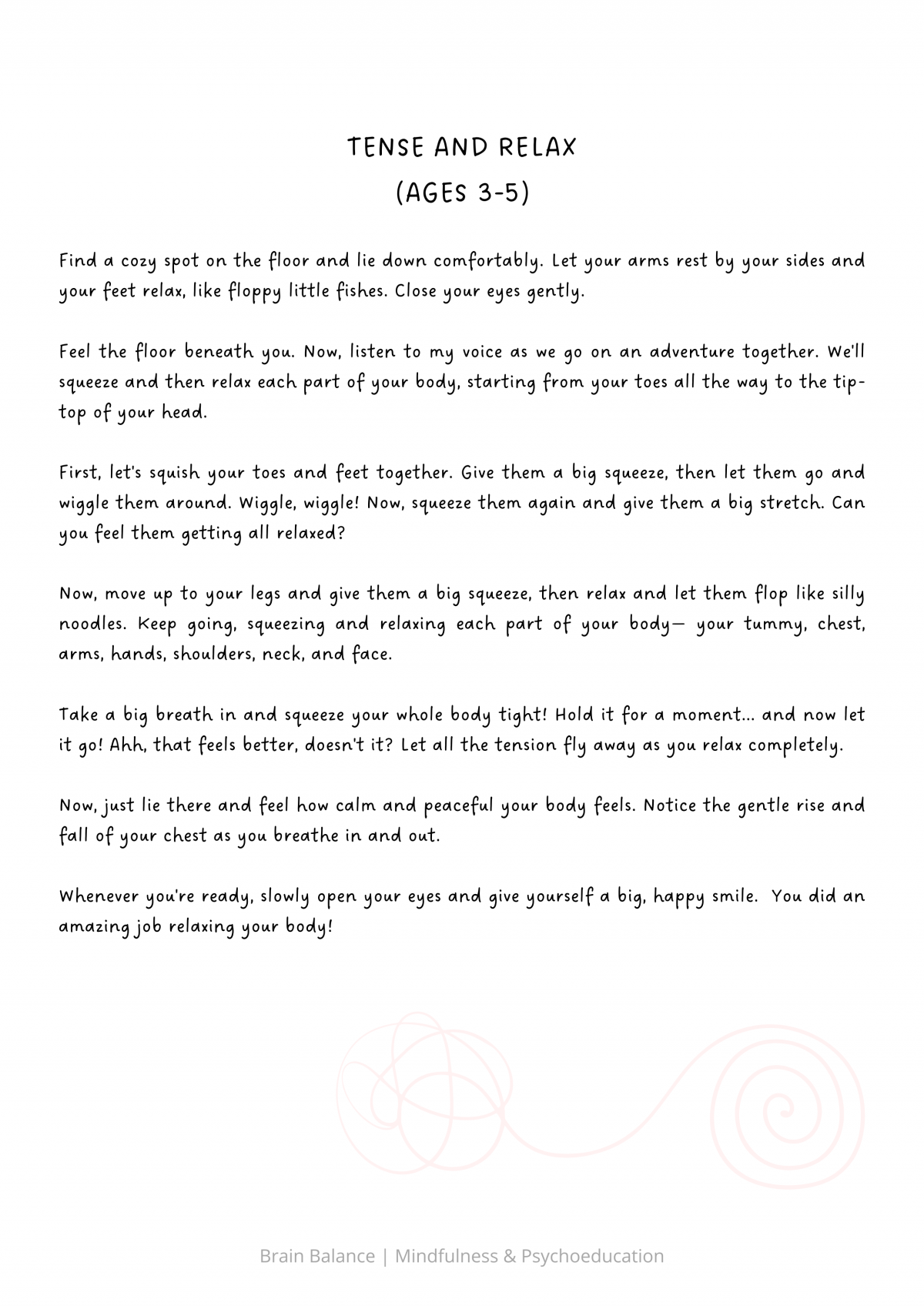
TENSE AND RELAX | ages 6-10 | 8 min
Unlock a world of relaxation with this meditation technique tailored for children aged 6-10. Through a series of gentle movements, each body part is invited to both tense and relax, allowing young minds to explore the sensations that arise with each motion. This technique, akin to progressive muscle relaxation, offers a playful yet profound way for children to cultivate mindfulness and inner calm.
Script: Tense and Relax (ages 6-10)
Download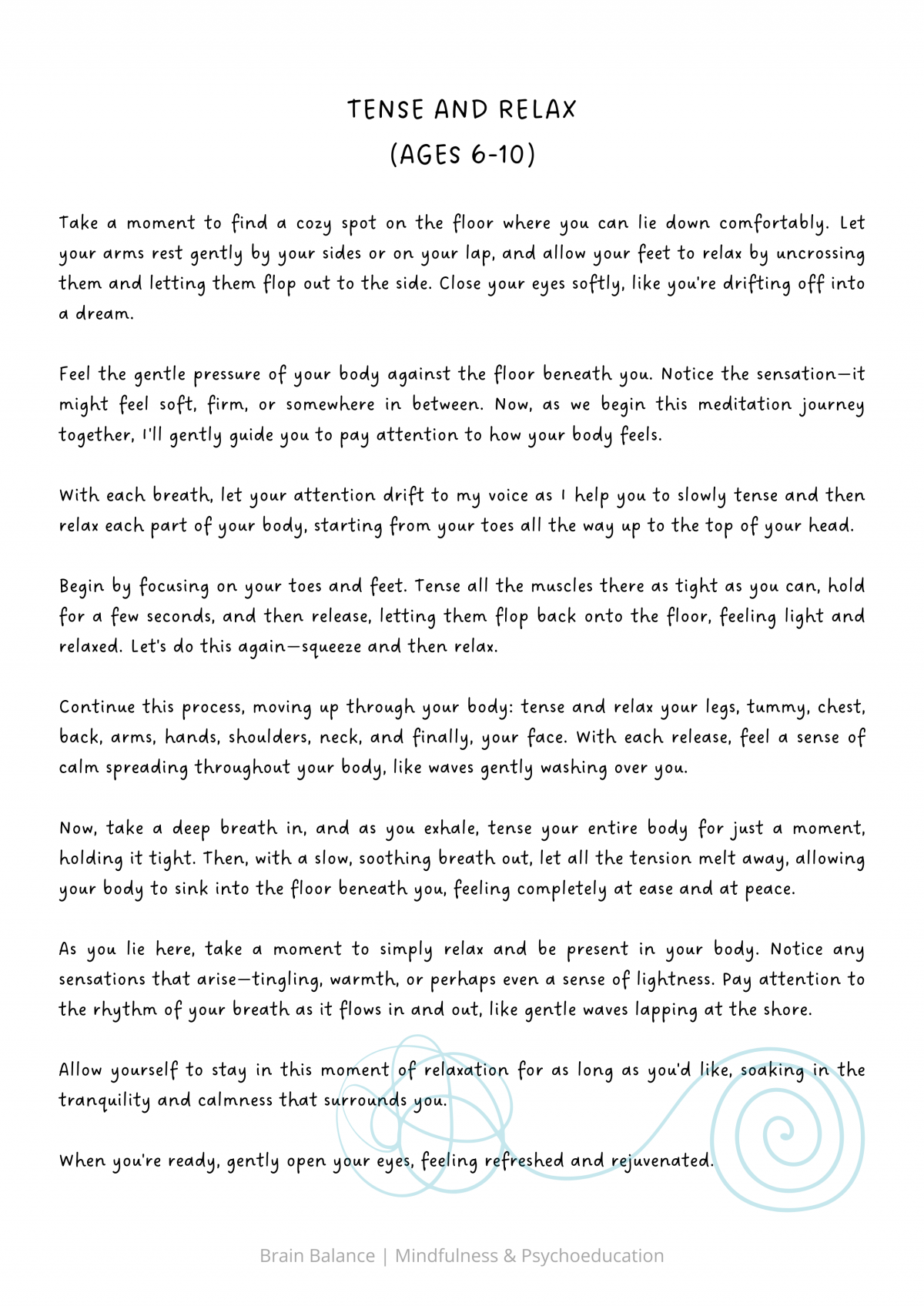
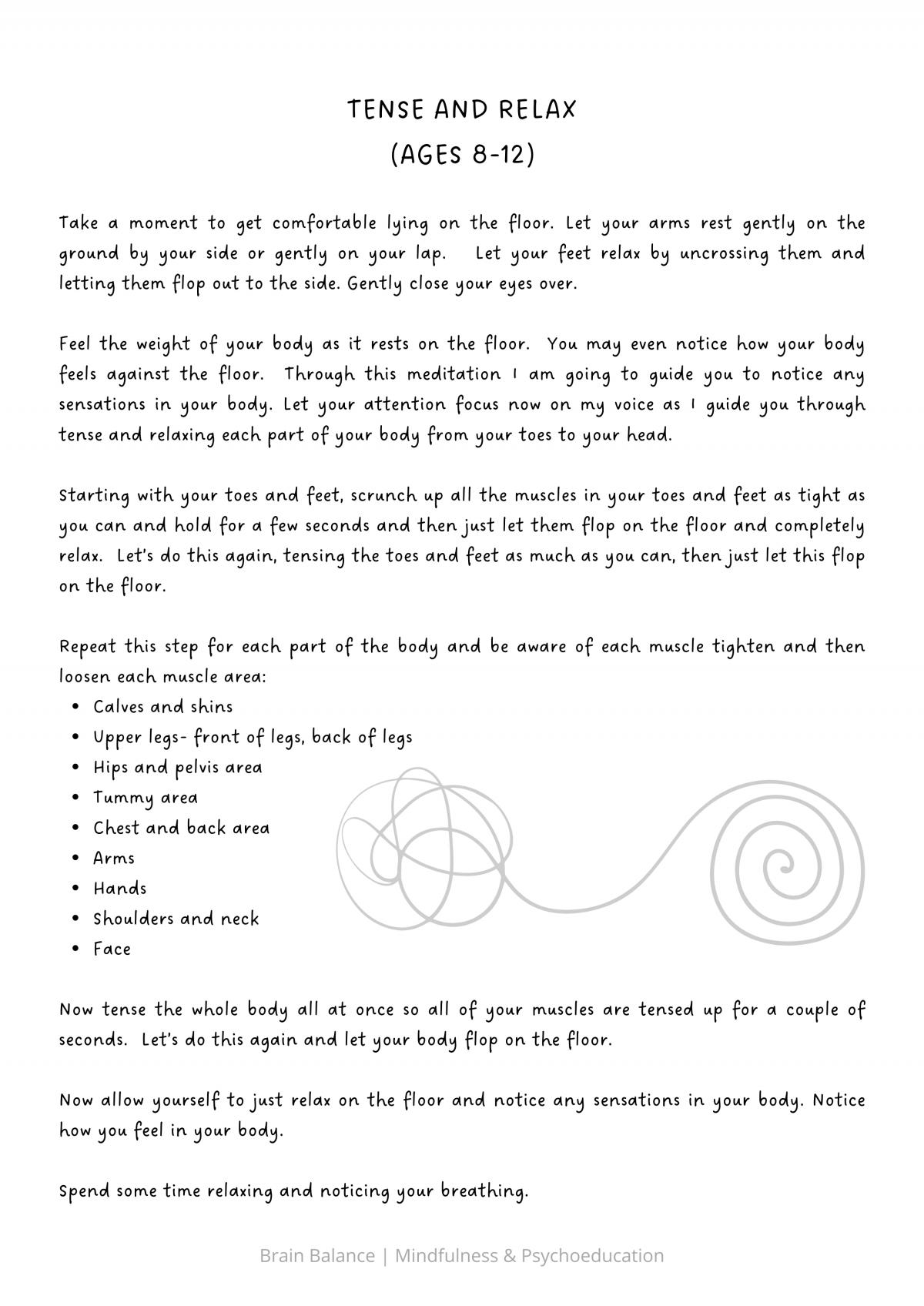
TENSE AND RELAX | ages 8-12 | 9 min
This meditation encourages older children and adults to notice their bodily sensations and build awareness of their bodies and is a great way to get to sleep. Children tense up each part of their body and then let it go, relax it, and notice how their body feels during this process. This is very similar to progressive muscle relaxation, but the focus is noticing the sensations they feel in each part of their body.