Week 2 - Lesson Plan
Overview
- Opening: 3 mindful breaths.
- Sharing: To identify how they are feeling, learn names for feelings and gain more insight into their own feelings through "Feeling Cards" sharing time.
- Activity: Storytelling ("My Magic Breath" book), craft: (making pinwheel), movement (chair yoga cards - stretching)
- Meditation: An introduction into Mindfulness meditation through the Breath Meditation (Breath Meditation for ages 8-12, or Breath Meditation "Whimsical Pinwheel" for ages 6-8). Children will learn how to calm themselves down when they are feeling anxious/stressed by doing breath meditation.
- Concentration game: memory game "Carrots"
- Closure: reflections.
Opening
- Greeting the children. Fill up a list of children present in the class and count the children.
- Mindful Breaths: Each child gets a turn with the "Hoberman sphere/breathing ball," using it to practice deep breathing. After taking deep breath, the child passes his ball to the next student. Once the balls have made their way around the entire circle, they return to the teacher. This exercise helps the children focus on their breathing and learn the calming effects of deep breaths.
Sharing Time
We want the children to be able to at least identify the feelings of happy, sad, calm, peaceful, angry, scared, worried, and nervous to help during the program. This will also help them to identify their own feelings in the future and see how this relates to their times of worrying so they develop insight and self-awareness.
- Spread out the Monkey Feeling cards (happy, calm, peaceful, joyful, excited, sad, scared, angry, worried, nervous)
- Children see if they can group the feelings into types of groups, letting the children decide what type of groups they may be in. They may give the groups their own names such as ‘good’ feelings or ‘nice’ feelings. Children share why they think they match or are grouped together.
- They may share how they like or dislike to feel a certain way.
- Discussion: Why is it important to know how we are feeling? Children can share: Feelings can tell us …. Or Feelings help us because…
- Explain: It can be helpful to share your feelings with other people so they can help you, by sharing our worries they also feel lighter, like in our story we read last week "Ruby's Worry".
- Ask: Do you always know how you are feeling? A way to help us to work out how we are feeling is to spend some time stopping and noticing our feelings. One way to do this is to do a meditation exercise. When we meditate it helps us to connect to how we are feeling and you will be learning more about this during the program as we go along.
Activity
Meditation
- Introduce the Breath Meditation and how we focus our attention just on what our breath is doing – we don’t need to change the breath at all – just notice it. Explain we are just noticing our breath mindfully which means to use all of our mind to notice our breath rather than thinking about other things.
- Explain that our minds will wander and think about lots of things which is completely normal. When you notice that your mind has wandered just simply and gently bring your focus back to your breath. This may need to be done many times during a meditation exercise.
- Children sit or lie down and hold their pinwheels to practice breathing during meditation.
- Guide children through ‘The Breath’ Meditation being guided by the script.
Game
- Carrot Colors Memory Game: Children take turns rolling a dice to find matching colors of wooden carrots. This game helps enhance their memory and concentration skills while they enjoy the challenge of finding pairs.
Closure
- Reflections - How are you feeling now? Do you feel it in any particular body part? What was easy to concentrate on today, what was difficult? Any thoughts in your head during any exercise, during meditation?
- Round of gratitude - pass the monkey (or any other group's favourite object) and say what you are grateful for today.
- Closing ritual - Use battery operated candles as a closing ritual when children blow down the candles using 3 mindful belly breaths. The session is finished.
- Count the children and send them back to the teacher/their class.
- Battery operated candles x3
- Speaker for relaxing music in the background
- Pillows for children to sit on
- Monkey Feeling Cards
- Star projector (turn on during meditation)
- "My Magic Breath" book
- Materials for making pinwheels
- Chair yoga cards
- Scripts for Breath Meditation ("Pinwheel")
- Concentration memory game "Carrots"
BREATH MEDITATION | "Colorful Pinwheel" | ages 3-5 | 5 min
This enchanting pinwheel meditation is specially crafted for little children aged 3-5, providing a whimsical journey to help them connect with their breath. Through the vibrant imagery of a colorful pinwheel, little ones are invited to visualize their worries gently fading away with every magical breath. As the breath, a constant companion, guides them, this meditation becomes a delightful and age-appropriate tool to nurture mindfulness and focus on the joyous present moment.
Script: Breath Meditation "Colorful Pinwheel" (ages 3-5)
Download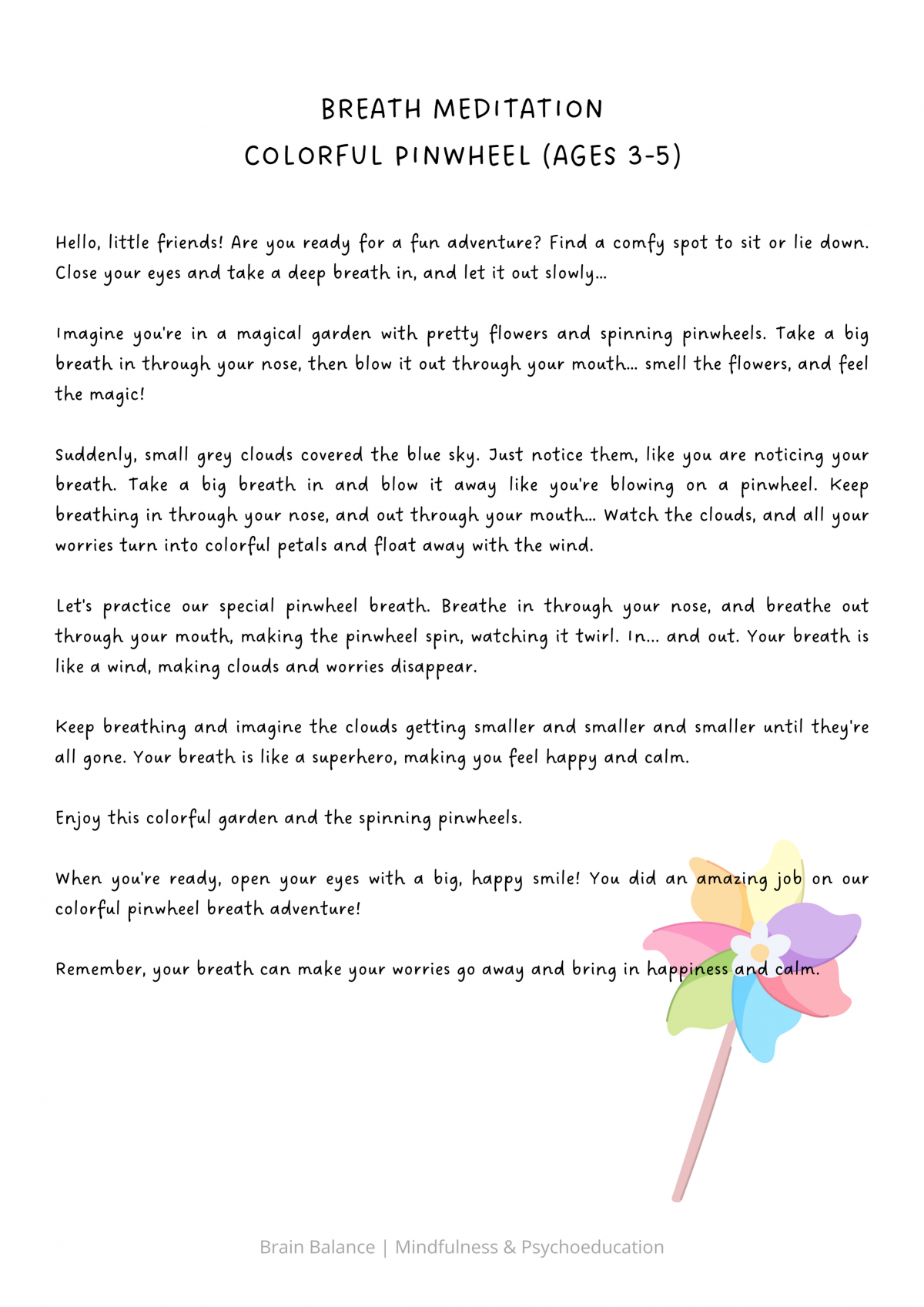
BREATH MEDITATION |"Whimsical Pinwheel" | ages 6-10 | 8 min
This delightful pinwheel meditation is tailored for children aged 6-10, offering a playful and engaging way to connect with their breath. Through the vivid imagery of a vibrant pinwheel, kids are encouraged to visualize their worries magically dissipating with each rhythmic breath. By anchoring their attention to the present moment through the breath, this meditation becomes a charming and effective tool for fostering mindfulness in a manner that resonates with the imaginative spirit of older children.
Script: Breath Meditation "Whimsical Pinwheel" (ages 6-10)
Download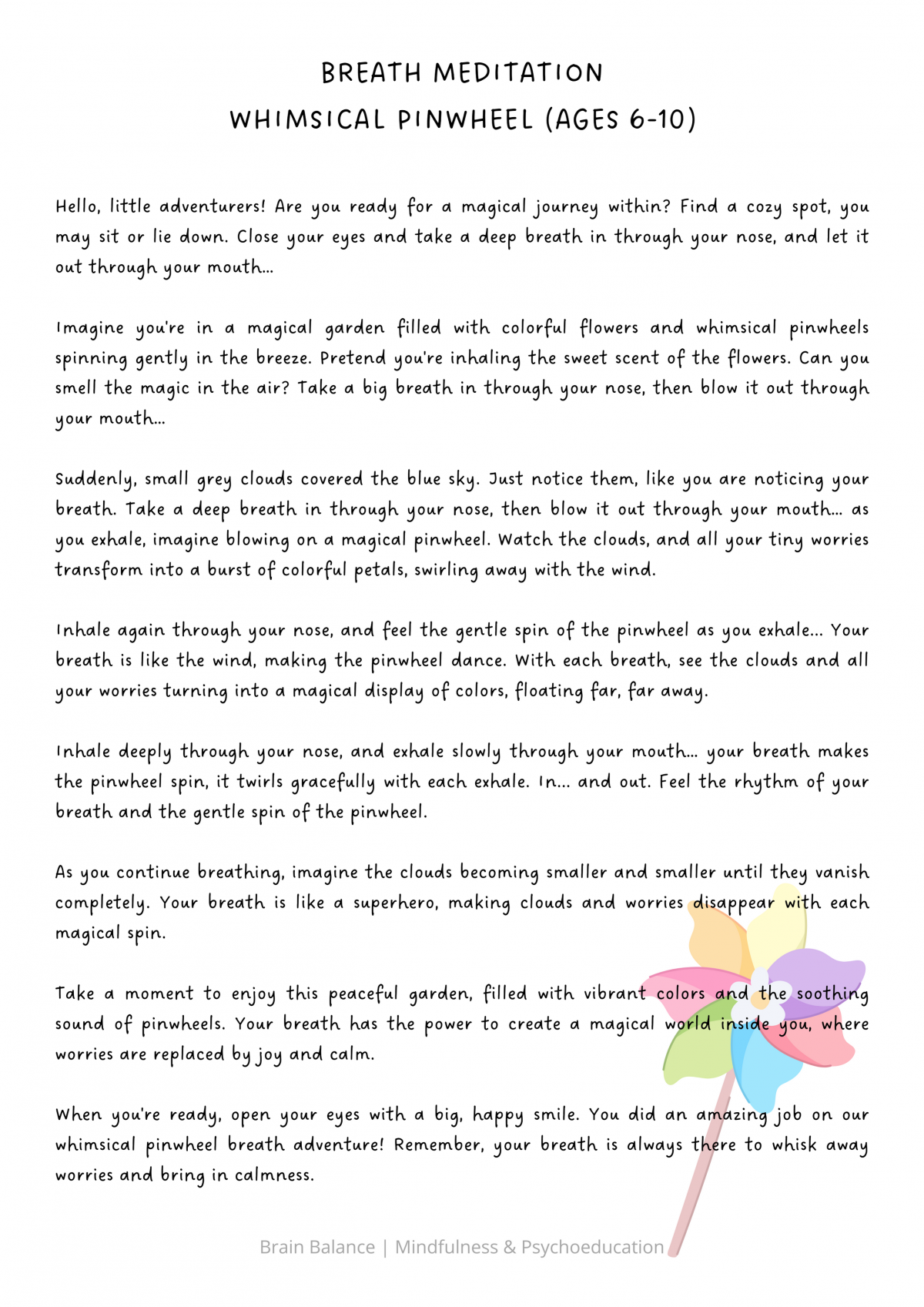
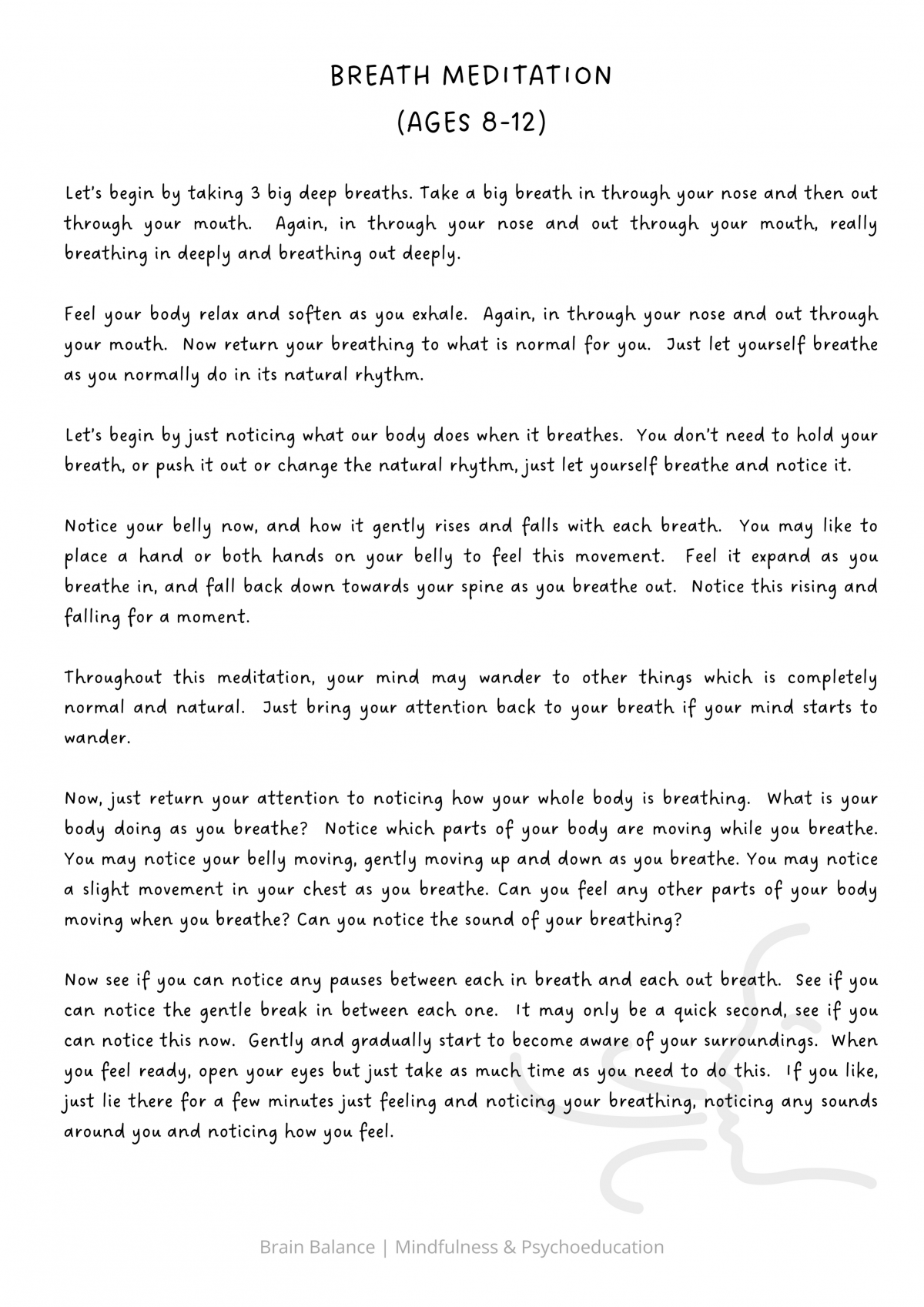
BREATH MEDITATION | ages 8-12 | 8 min
This meditation helps older children (ages 8 and up) and adults connect with their breath and begin to notice their breath. As the breath is always with us, connection with the breath becomes a powerful way to focus on the present moment.