Week 3 - Lesson Plan
Overview
- To identify how they and others are feeling, learn names for feelings and gain more insight into their own feelings through "Feeling Cards" sharing time.
- Activity: storytelling ("Meesha Makes Friends" book), craft (planting seeds)
- Mindful Belly Breathing Meditation (Breath Meditation for ages 8-12, or Breath Meditation "Seed of Kindness" for ages 6-10).
Opening
- Greeting the children.
- Fill up a list of children present in the class and count the children.
- Quick opening with 3 mindful belly breaths, (this time use a feather to pass in a circle, each child blows once)
Sharing Time
- What did you discover when you did the meditations at home?
- How have you been feeling lately? Use the "Monkey Feeling" cards (lonely, afraid, sad, nervous, joyful, excited, happy, energetic), children choose (point) a card or two of how they have been feeling. Share if they like and if they want to open up to why they feel that way, let the conversation just flow without asking any direct questions. Just show them you are listening and care and encourage others to listen as well, by using the reflective listening technique.
- What is a worry? (Give children a turn to explain if they wish). A worry is a thought that makes you feel scared, upsets you or makes you just feel bad. Worries can also give you physical symptoms like feeling sick or fluttery in the tummy, dizzy, having dry mouth, headache or fast heart beat.
- Being worried or anxious, is a feeling just like other feelings such as feeling joy, happiness, sadness. Feeling worried or anxious happens sometimes to everyone and it is completely normal. Sometimes we can get worried a lot and then we don’t have as much fun or like doing things as much. During this program you will learn how to manage your worries, how to relax, so you feel better.
- Mindfulness helps us to switch off from having these thoughts, and not get stuck in thinking about worries too much.
- What do kids worry about? (Give children a turn to share their worries if they wish. Use reflective listening technique to support children with their worries, rather than having to find solutions to their worries or talk more about them). Spread “Worry Cards” on the floor (heights, getting sick, if people like me, being alone, sleeping problems, being on time, speaking in front of a group, fights with friends, storms/fires/floods, flying on a plane) if children feel comfortable they can point to the cards that relates to them, you may too.
Activity
Picture book for helping children navigate social situations and connect with peers. While reading the book for the children make the experience as interactive as possible, engaging children in the story by asking them questions how is Meesha feeling, how are other children feeling.
- Have prepared pots, flower pot stands, soil, water spray, seeds, shovel. Some children might need more of your help in putting the soil into the pots.
- What does a plant need to stay healthy? Get the children to think of all the things plant need to grow and stay healthy. Explain that for the plant to grow it needs regular care and regular watering for nourishment. It needs also soil, sunshine and air.
- How we can stay healthy in our bodies and minds? Get the children to think of ideas. Explain that similar to plants we also need to drink water daily, so we can stay healthy. For our bodies to stay healthy we need also sunshine, air, exercises, nourishment and vitamins from the food.
- But what about our minds? We can stay healthy in our minds by spending some time each day practicing mindfulness meditation. This will help our minds stay strong, feel calm and happy and cope better with life. Without this nourishment we can become stressed, worried and anxious.
- Children take plants home. Instruct them to water their plants daily, put them in a place that has sunshine. Whenever they water their plants, they can remember as well to listen to their meditations to nourish their minds.
Meditation
- Introduce the Mindful Belly Breathing (MBB), this technique will help you to calm down straight away when you are feeling strong emotions. When we are feeling stressed we tend to just breath into our upper chest which makes us take little breaths. Often, we breathe into our chest area and lift up our shoulders which does not calm ourselves down. We need to do opposite to feel calm. Show children an example of high chest breathing by lifting up your shoulders and taking small breaths.
- The Mindful Belly Breathing focuses on our belly to ensure we breathe deeply. Practice a couple of breaths with the children holding your hands on your belly while breathing. Show them how your hands are going up and down while you breathe in and out.
- Children may place “breathing buddy – monkey” on their belly while lying down and notice that it rises up and down when breathing in and out.
- Guide children through ‘Seeds of Kindness’ Meditation being guided by the script.
Game
- Concentration Game: "Go Away Monsters" (memory game)
- Mindful Game: "What feeling am I?" - Spread 8 Feeling Cards (lonely, afraid, sad, nervous, joyful, excited, happy, energetic), direct the children to close their eyes, place the cards face down, and have each child pick one without revealing it. Encourage them to express the chosen feeling through gestures, facial expressions, and body language while others try to guess the emotion.
Closure
- Reflections - How are you feeling now? Do you feel it in any particular body part? What was easy to concentrate on today, what was difficult? Any thoughts in your head during any exercise, during meditation?
- Round of gratitude - pass the monkey (or any other group's favourite object) and say what you are grateful for today.
- Closing ritual - Use battery operated candles as a closing ritual when children blow down the candles using 3 mindful belly breaths. The session is finished.
- Count the children and send them back to the teacher/their class.
- Battery operated candles x3
- Speaker for relaxing music in the background.
- Pillows for children to sit on.
- Monkey Feeling Cards
- Star projector (turn on during meditation)
- "Meesha Makes Friends" book
- Materials for planting seeds (pots, flower pots stands, seeds, soil, water spray, shovel)
- Scripts for Mindful Belly Breathing meditations (“Seed of Kindness”)
- Hoberman Sphere, Pinwheel
- Go Away Monsters - Memory Game
MINDFUL BELLY BREATHING | "Seed of Kindness" | ages 3-5 | 5 min
This enchanting meditation helps children find calmness, focus on the present, and understand the magic of kindness in making their hearts happy. Let's embark on a magical journey with our "Seed of Kindness" meditation designed for little ones aged 3-5! Close your eyes, take a deep breath, and envision holding a special seed that transforms into a happy kindness plant. Feel the warmth as you breathe in and out, allowing the seed to flourish in your heart's garden. Engage in playful belly breathing, imagining the seed growing taller with every breath, spreading joy and love.
Script: Mindful Belly Breathing "Seed of Kindness" (ages 3-5)
Download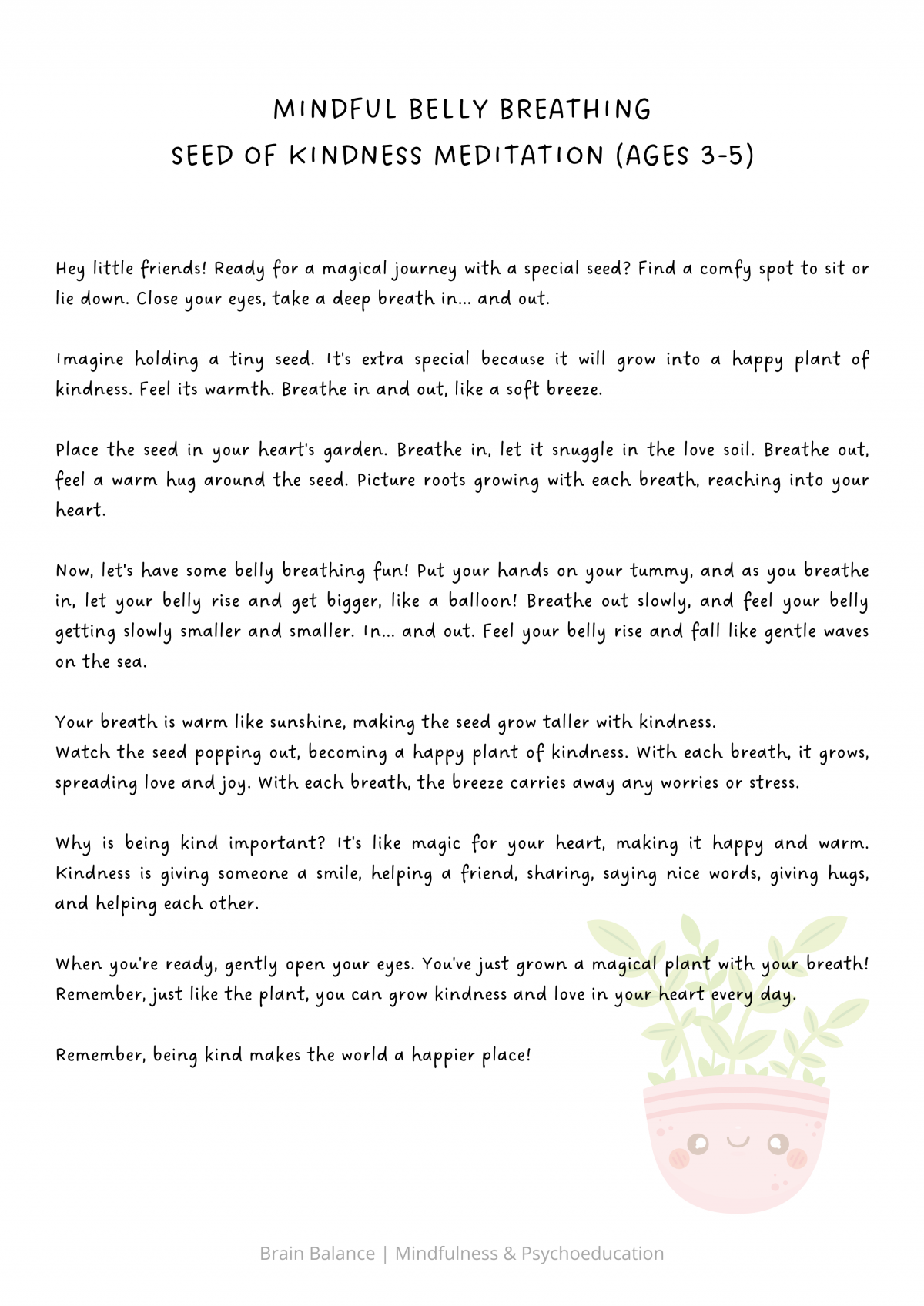
MINDFUL BELLY BREATHING | "Seed of Kindness" | ages 6-10 | 7 min
Embark on a magical journey with our "Seed of Kindness" meditation tailored for older kids aged 6-10! Close your eyes, take a deep breath, and visualize holding a special seed destined to blossom into a vibrant kindness plant. Sense the warmth as you breathe in and out, cultivating the seed in the garden of your heart. Engage in mindful belly breathing, envisioning the seed thriving with each breath and spreading positivity. This captivating meditation empowers older kids to find serenity, shift focus to the present, and recognize the enchantment of kindness in nurturing their hearts.
Script: Mindful Belly Breathing "Seed of Kindness" (ages 6-10)
Download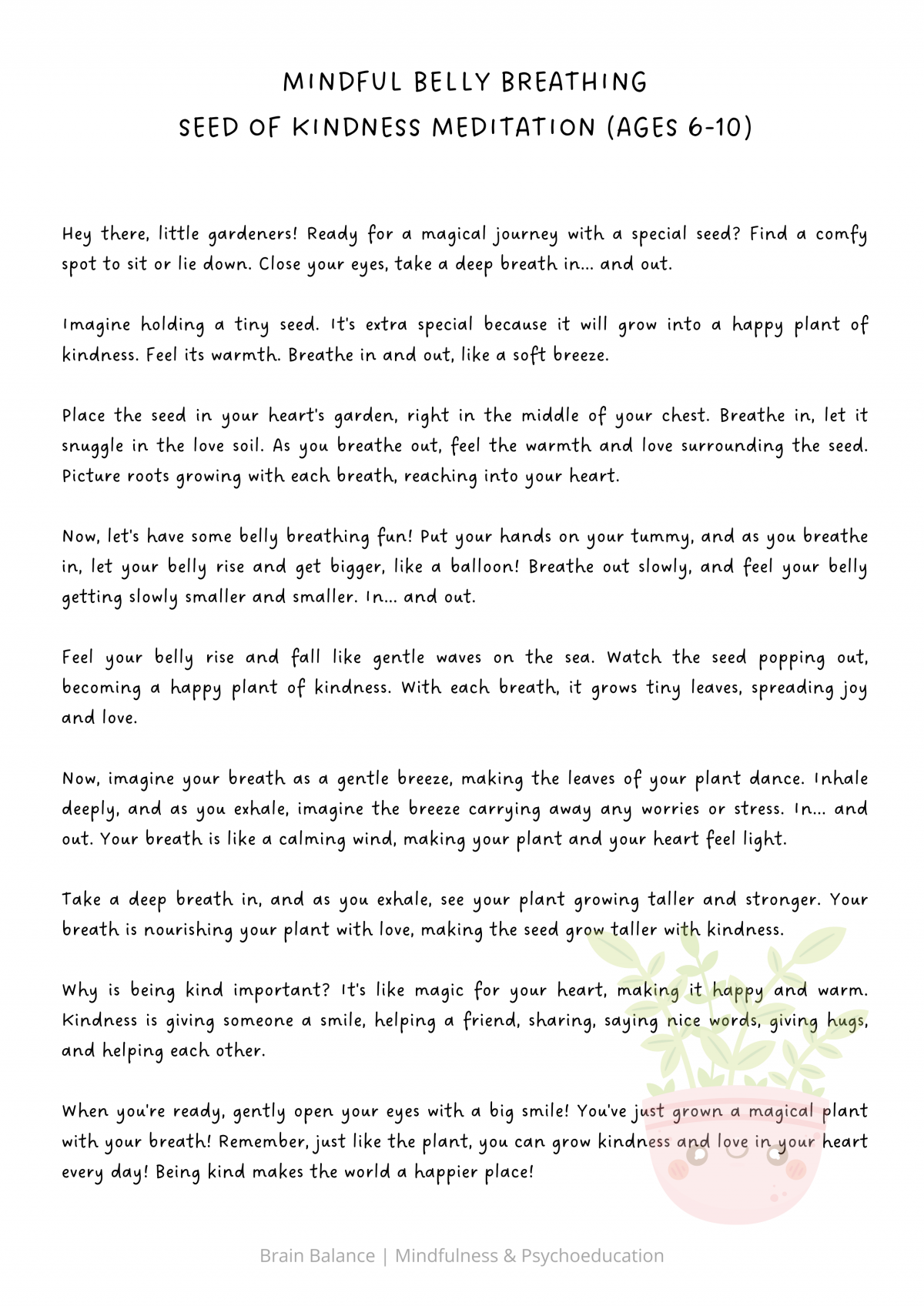
MINDFUL BELLY BREATHING | ages 8-12 | 5 min
This meditation helps children, teens, and adults to calm down when they feel upset, worried, stressed, or any extreme emotion. It helps them to self-soothe and manage their own emotions by changing their physiology. Focusing on their breath, helps children to shift their focus off worrying thoughts and onto the present moment.