Week 4 - Lesson Plan
Overview
- To identify how worrying makes us feel and how it affects our bodies.
- Simple brain anatomy and stress response (amygdala).
- Activity: storytelling ("Hey Warrior" book), craft (making brain), mindful game (“Emotion Charade")
- Body Scan Meditation
Opening
- Greeting the children.
- Fill up a list of children present in the class and count the children.
- Quick opening with 3 mindful belly breaths – “Pass the Breath” (this time use a feather, each child picks their own feather, and blows it 3x)
Sharing Time
- How have you been feeling lately? Use the "Monkey Feeling" cards x 8 (loving, happy, excited, cheerful, grumpy, panicky, worried, anxious), children choose (point) a card or two of how they have been feeling.
Explaining the stress response - ‘smoke alarm’
- Recap from last week’s discussion that worrying is a normal human emotion and response however at times we can worry too much which does not help us, however feeling worried and being scared has a purpose.
- Being worried or scared can be helpful at times – imagine a big lion roaring at us and running towards us. How would we feel? (Scared) Why would it be important to feel worried/scared? (So we can take action and run away) And how does it help us? (It protects us and keeps us safe). Therefore, it is normal to have these feelings and responses as they help to protect us from danger. However, we don’t want to be worried when we don’t need to and when we are safe.
- Our body does several things so it can be ready to fight the danger, flee danger or freeze so we don’t get noticed. We all have this Fight, Flight or Freeze response – this helps to keep us safe.
- When we get worried an alarm system like a ‘smoke alarm’ turns on (Amygdala). This is the activation of the stress response. This then helps our bodies respond so we can protect ourselves.
- Our muscles tense up so we can run, our heart races and pumps fast so it can pump oxygen around the body. This can then cause us to feel a bit sick or even dizzy. Our heart rate increases to pump oxygen to our major muscles, we get adrenaline and cortisol pumping through our body to give us energy. These responses are really normal as it helps to protect us, and it is our bodies’ way of preparing us for danger and stops us getting hurt. At times it is appropriate for the alarm to be activated and this needs to be trusted.
- However often the “smoke alarm” turns on when it doesn’t need to. This is when we worry about something that is not dangerous to us (even though it feels like it is). Our minds can think there is danger, and it feels scary, and our bodies still react to this danger even though it is not real.
- We can however calm down our bodies and turn off the ‘smoke alarm’ by calming ourselves down with Mindfulness Meditations, practising the MBB technique or doing something fun or relaxing.
- Do you know when your smoke alarm turns on? When is it a false alarm (no danger) or when there really is smoke? (Danger). You may like to give a simple example of when your smoke alarm turned on even though there was no danger. Children share when their smoke alarm has turned on for events that really are scary and for events that we are just imagining are scary (false alarm).
- Get the children to place a hand on their forehead – explain that the pre-frontal cortex is behind the forehead. This is the ‘thinking brain’. This helps us to think well and to keep ourselves calm. Then place a hand behind the back of the bottom of the skull. Behind here in the brain is the ‘Amygdala’ which is the ‘smoke alarm’ centre of the brain. Explain that when the amygdala is working (the alarm bell turns on) we can feel stressed and then the thinking part of the brain doesn’t work too well.
- Mindfulness helps to “turn off” the amygdala (smoke alarm).
- Show children the illustration of the brain and the different parts of the brain.
- It’s important to know when our bodies are reacting from the smoke alarm turning on because then we can do something about it such as the Mindful Belly Breathing technique, listen to a Mindfulness Meditation or doing something fun or something that makes us feel good.
- Explain they will also learn a few more meditations and coping strategies in the next few weeks that will help them to also turn off the smoke alarm.
Activity
Lay out the chair yoga cards (twist) face down and have each child pick one card at a time. The whole group then performs the activity shown on the card. Continue until all the cards have been used. This exercise helps the group stretch together, adding variety and fun as they anticipate which pose will be next.
Meditation
- Get children to close their eyes and see if they can notice where they can feel any body sensations. Explain that these can be tingling, numbness, pain, aches, throbbing, hot or cold etc.
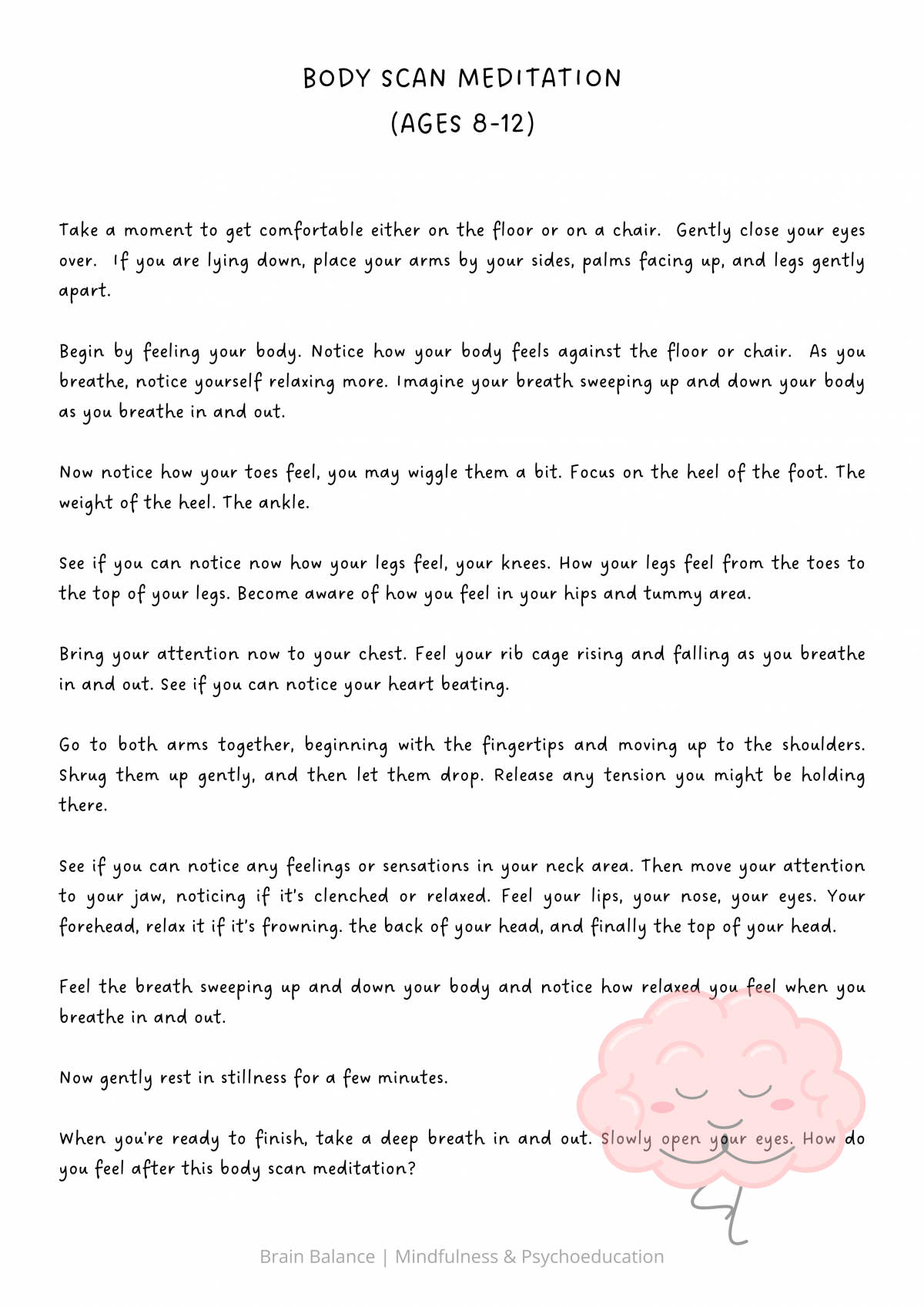
- Guide children through the ‘Body Scan’ meditation. Let them share how they feel after the meditation and whether they can notice any difference in their bodies. Share if they noticed any sensations in their body that they have not noticed before.
- Explain that practicing this regularly helps the mind and body to relax, it turns off the ‘smoke alarm’ and helps us to stay more relaxed. It also ‘tunes’ us into our bodies so we can experience how we are feeling and label how we are feeling with an emotion such as feeling anger in the body or feeling scared in the body.
Game
- Concentration Game: "Wobbly Cactus" (promotes concentration, and hand-eye coordination)
- Mindful Game: “Emotion Charade” (each child picks the card and plays that emotion, other children try to guess the emotion, play until cards are finished).
Closure
- Reflections - How are you feeling now? Do you feel it in any particular body part? What was easy to concentrate on today, what was difficult? Any thoughts in your head during any exercise, during meditation?
- Round of gratitude - pass the monkey (or any other group's favourite object) and say what you are grateful for today.
- Closing ritual - Use battery operated candles as a closing ritual when children blow down the candles using 3 mindful belly breaths. The session is finished.
- Count the children and send them back to the teacher/their class.
- Battery-operated candles x3
- Speaker for relaxing music in the background.
- Pillows for children to sit on.
- Monkey Feeling Cards (sharing time).
- Star projector (turn on during meditation)
- "Hey Warrior" book.
- Brain model.
- Materials for making a brain (brain mold, playdough of different colors).
- Scripts for Body Scan meditation.
- Wobbly Cactus - concentration game.
- Chair Yoga Cards - Twist
BODY SCAN | ages 3-5 | 5 min
This delightful body scan meditation takes young children on a journey of self-discovery. Children can playfully tighten and relax their muscles, feeling the comforting warmth along the way. The flow starts from their toes, goes up to the legs, continues to their shoulders, releasing any tension. This simple and fun exercise helps little ones become more aware of their bodies, fostering mindfulness through the joy of 'noticing' and exploring the sensations within.
Script: Body Scan (ages 3-5)
Download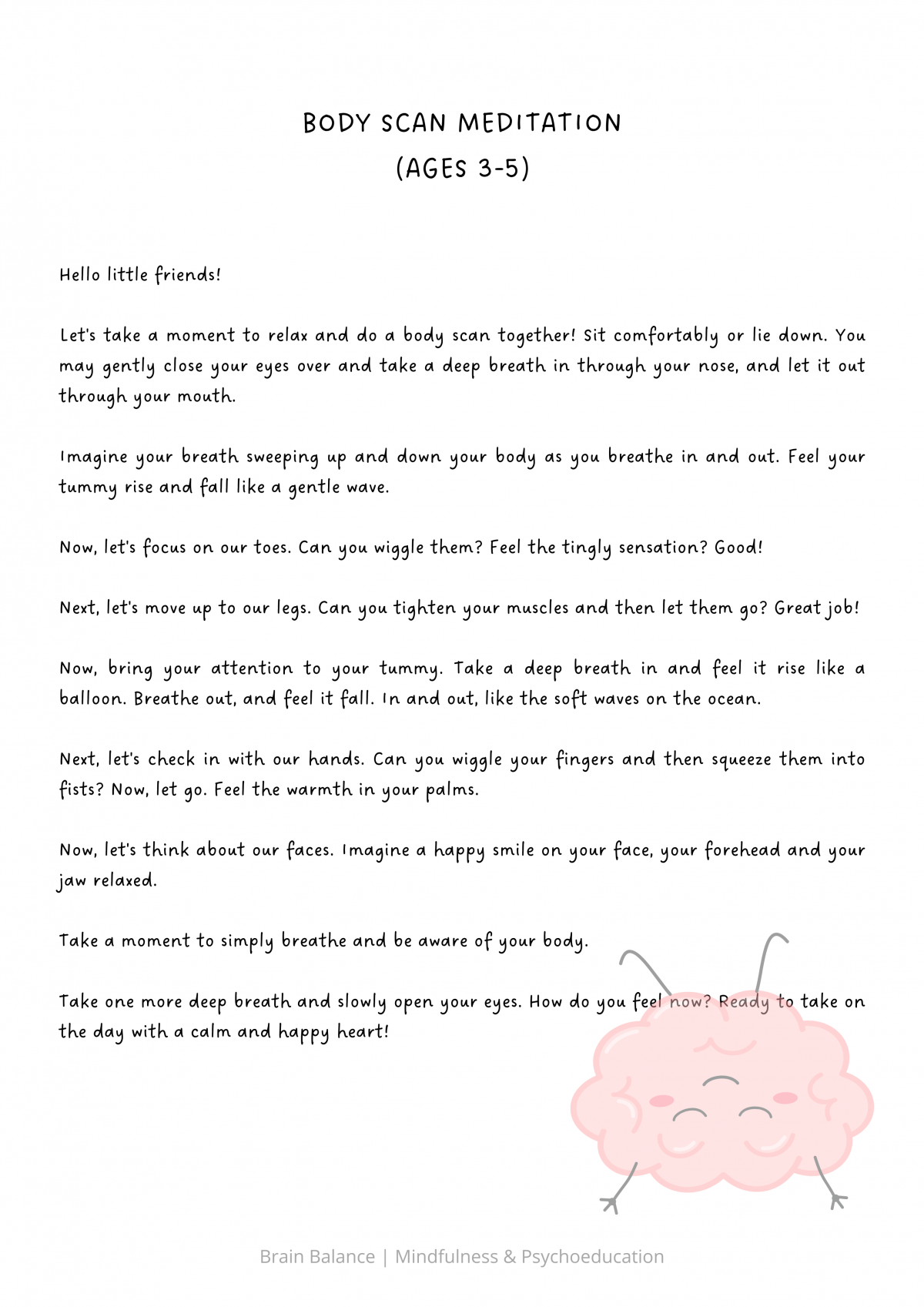
BODY SCAN | ages 6-10 | 7 min
This meditation encourages older kids to cultivate self-awareness and mindfulness by attentively 'noticing' their body sensations. A gentle, warm wave moves through the body, starts at the toes and travels to the knees, tummy, and hands. This meditation fosters body awareness in a relaxed, mindful manner, leaving a sense of calm and balance. By the end of the meditation, children will experience a tranquil and centered feeling, having taken a serene trip through the landscape of their own bodies.
Script: Body Scan (ages 6-10)
Download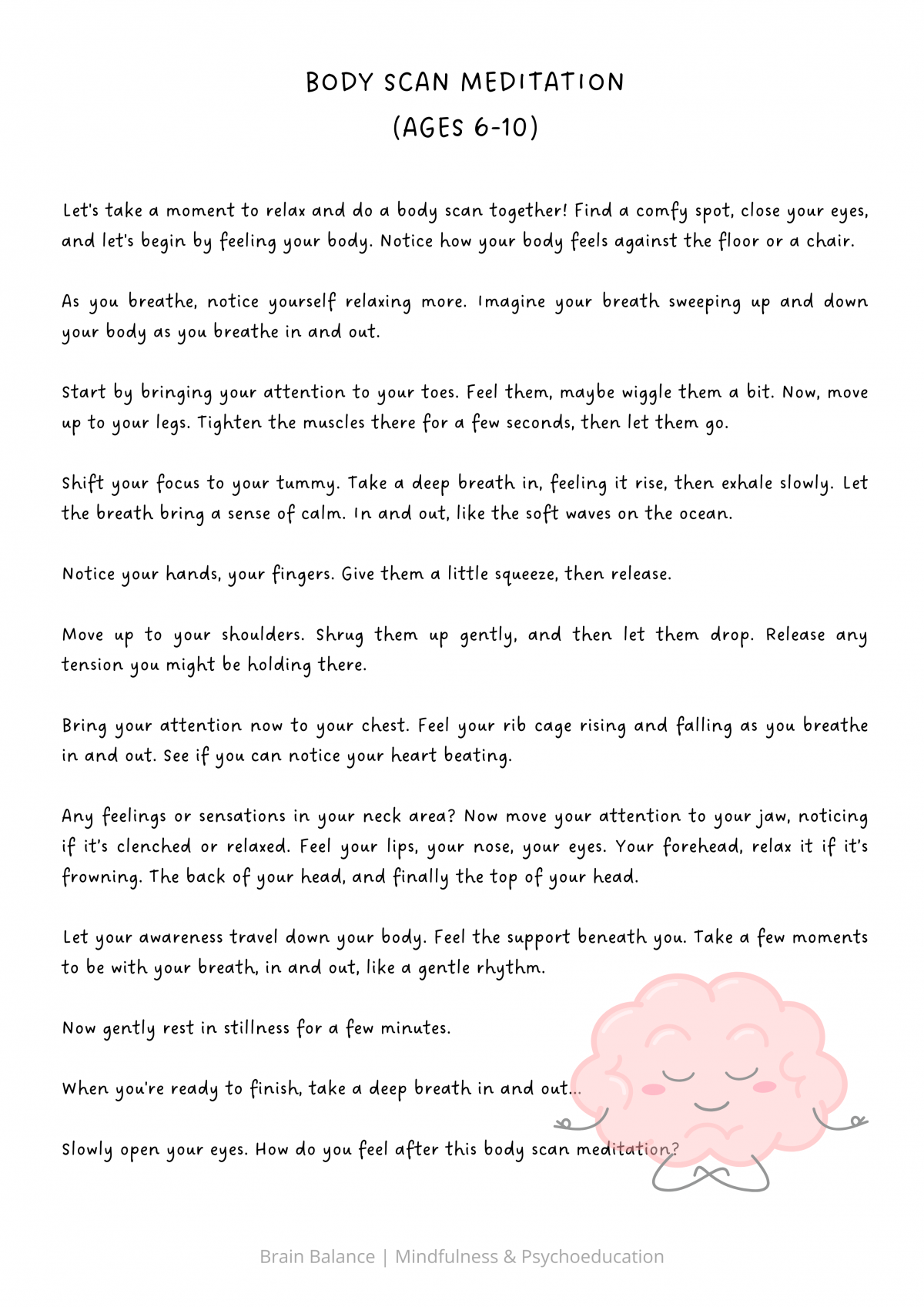
BODY SCAN | ages 8-12 | 13 min
This meditation enables older children and adults to simply notice their body sensations and become more aware of their body which in turn brings their awareness to the present moment in a non-judgemental way. This meditation helps children to practice mindfulness by developing their curiosity through just ‘noticing’ their body.